As Athens continues to improve mobility for people with disabilities, our accessible guides are frequently updated. Therefore, some instructions and tips in this itinerary may change, so please proceed with care.
This green and scenic route embarks from the National Garden, a one-time royal estate in the middle of Athens, and now, sprawling public oasis. Framing this much-loved Athenian sanctuary are many must-sees. From the Roman Baths, unearthed during excavations for the construction of the metro, to Emperor Hadrian's Arch, once the official gateway to the ancient city, and the glorious Temple of Olympian Zeus with its formidable columns.
Not far away, lies Ardittos Hill, cradling the Panathenaic Stadium, the beautiful white marble stadium—also known as Kallimarmaro—where the first modern Olympic Games were reborn in 1896.
Returning to the park, we will encounter the imposing Zappeion Megaron before winding up at the navel of modern Greek democracy: the Hellenic Parliament, and the Tomb of the Unknown Soldier, tirelessly guarded 24/7 by the legendary Evzones as a symbolic gesture. All just a heartbeat away from historic Syntagma Square and the Syntagma metro station.
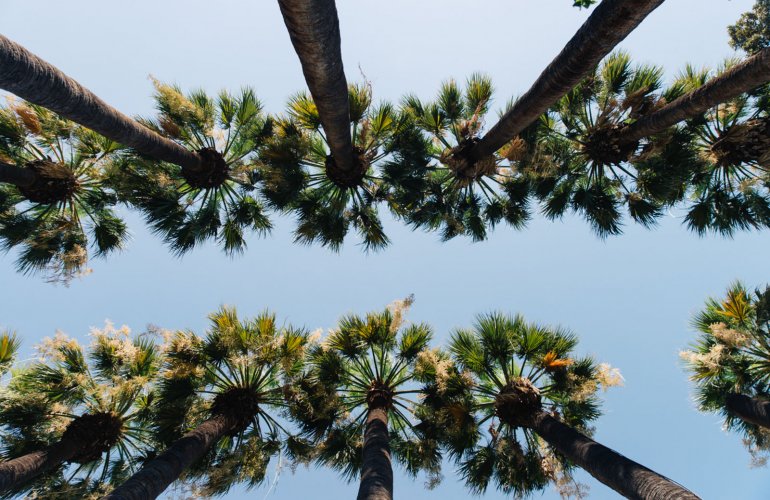
Photo: Thomas Gravanis
General Accessibility
- The itinerary is mostly flat with a total distance of about 3 km.
- It is well illuminated at night, except for some parts near Zappeion.
- It does not include tactile pavings for the most part.
- We recommend that you do not count entirely on the tactile pavings (wherever there are any at all), as they just supplementarily assist visitors with their orientation. Often, the tactile paving passes under high obstacles and they do not have colour contrast.
- At each point of interest, the accessibility is indicated according to the information available on each corresponding website.
- The itinerary starts from Syntagma metro station (line 3, “Airport - Nikaia” and line 2, “Anthoupoli- Elliniko”) and ends there as well.
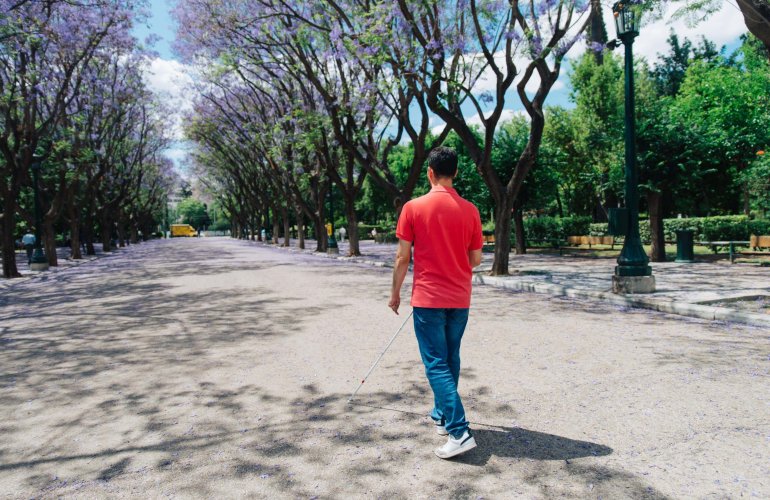
Photo: Thomas Gravanis
Points of Interests
Syntagma Metro Station
Lines 2&3
We exit Syntagma metro station using the stairs from the Amalias-National Garden exit. We are now on the pavement of Vasilissis Amalias Avenue.
We seek out the wall on the interior side of the pavement to our left and we follow it in a straight forward direction, always keeping the wall on our left as a reference point.
In a while we encounter a kiosk on our left. After we pass it, still on the pavement, we will locate the main entrance to the National Garden on our left.
If we do not enter the National Garden, walking straight down, we will reach another kiosk on our left, which marks the end of the entrance to the Garden.
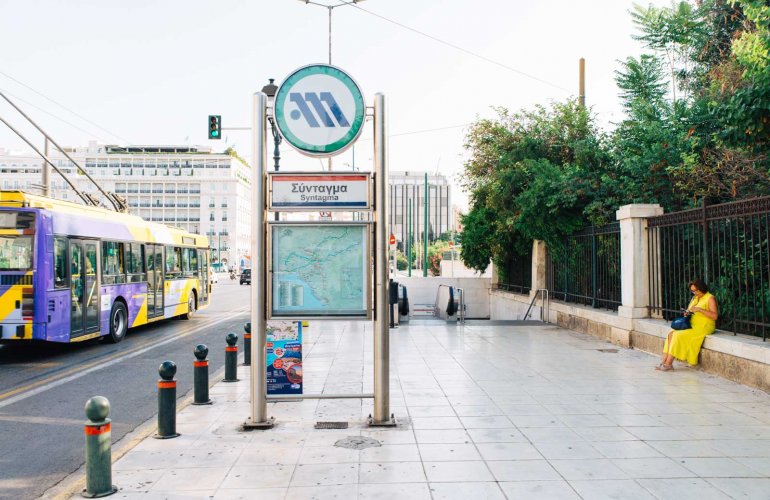
We exit Syntagma metro station using the stairs from the Amalias-National Garden exit. We are now on the pavement of Vasilissis Amalias Avenue.
Photo: Thomas Gravanis
The National Garden
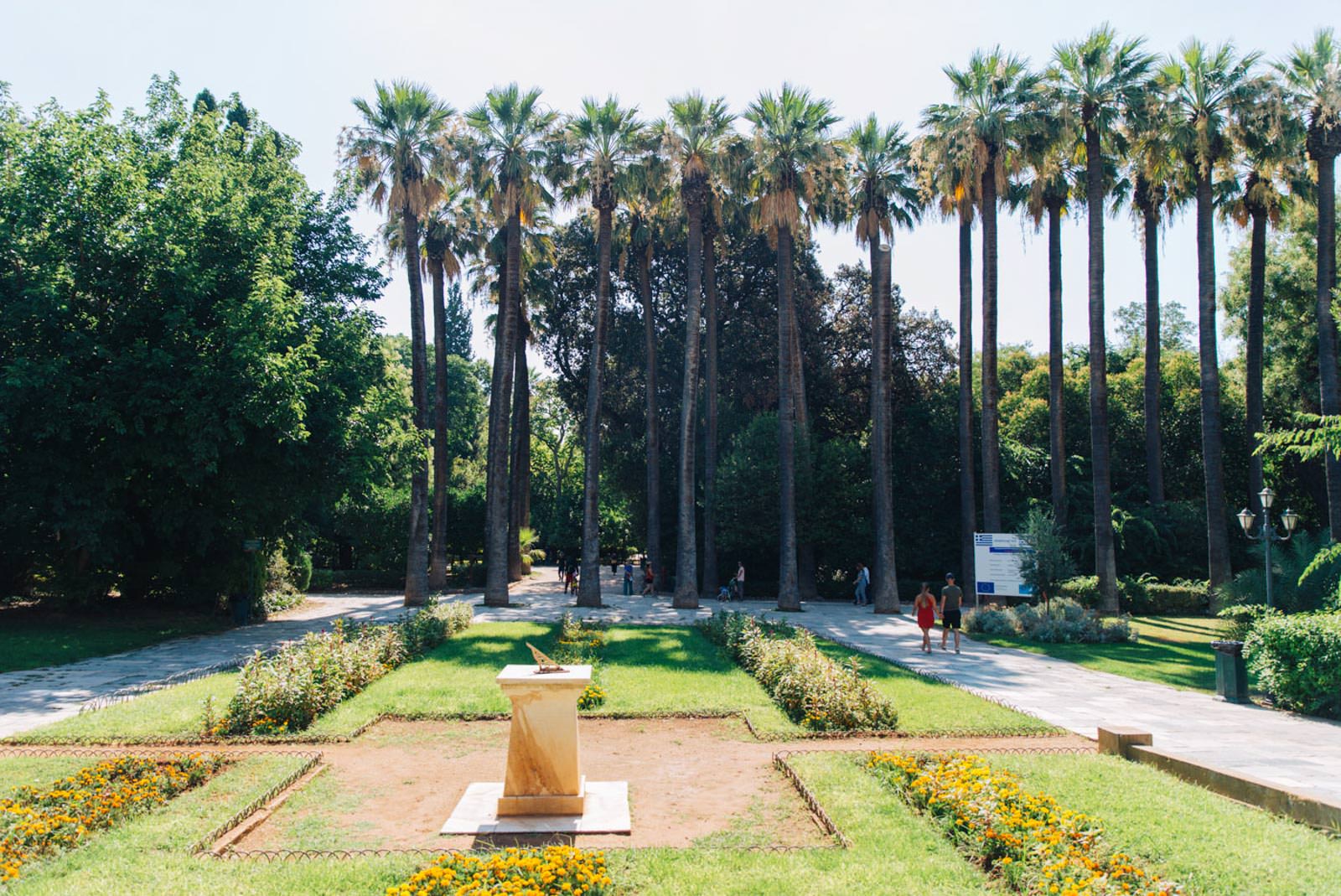
A national treasure fit for a Queen, this former royal garden was created in the mid-1800s and has been a focal point of Athenian life ever since it was declared a public space in 1927. You’ll find an impressive trove of plant and bird species in this 158,000-square-metre park, along with wrought-iron gazebos, turtle ponds and shady secluded nooks, perfect for picnics and lovebirds.
Exiting the National Garden from the same entrance we used to enter it, we turn left, bypass the kiosk on our left and keep walking straight.
Continuing along our route, we will meet benches at the interior left side, which we bypass and continue straight.
A little bit further down the road, on our left, we will discover the metal busts of the three most acclaimed tragedians in Ancient Greece, standing on plinths and marble columns: Euripides, Sophocles and Aeschylus (in this order from left to right).
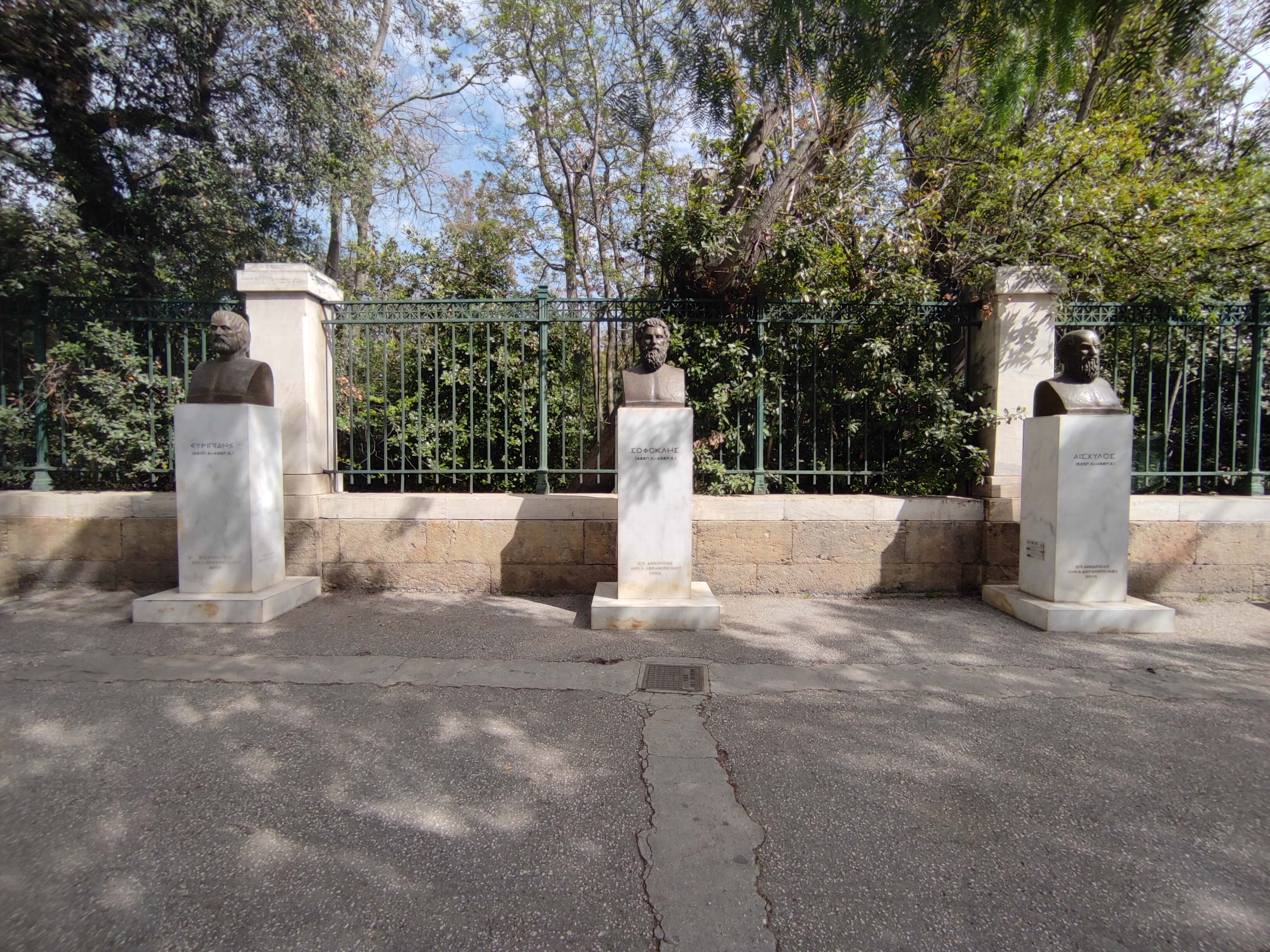
At the same spot, but at the opposite side of the road, on our right, we have the Russian Orthodox Church. On our left, there is another entrance for the National Garden.
Proceeding straight, we will meet a third entrance to the Garden on our left, as well as the Zappeion Megaron. At the same spot but across the street, on our right, we find St Paul´s Anglican Church.
We continue on a straight course, keeping in mind that for quite a few steps, due to the large span over which the entrance to Zappeion extends, we will not have the interior left side of the pavement as our guide, since it is interrupted by the entrance. After bypassing a small cafeteria on our left, we keep straight.
Continuing ahead, we step down a step, but we note that this is located on the same pavement that we are stepping on.
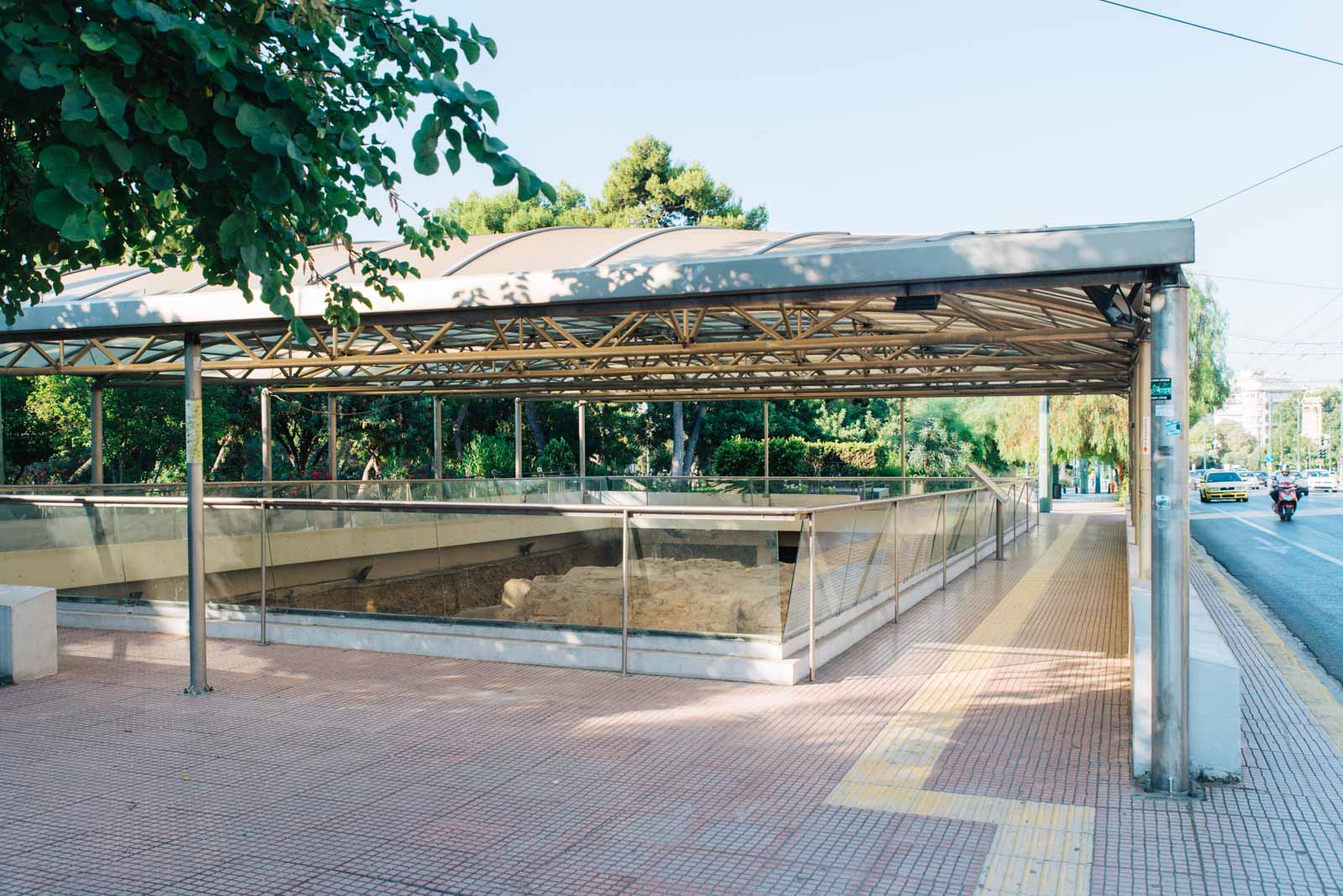
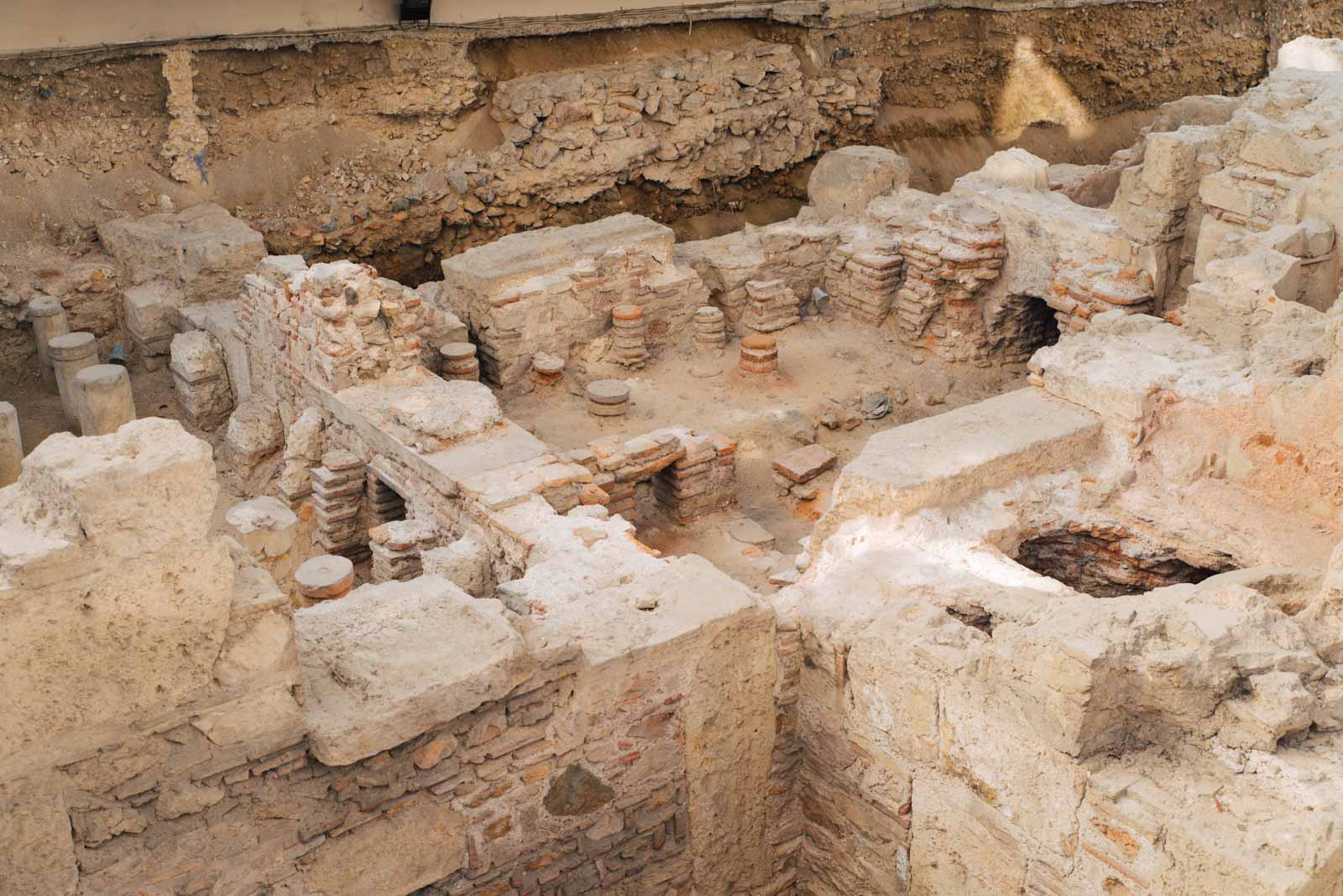
Continuing ahead, on our left, we will meet a fencing with a low handrail, which encloses the site of the Roman Baths, a non accessible site. The pavement now includes tactile paving for a few metres.
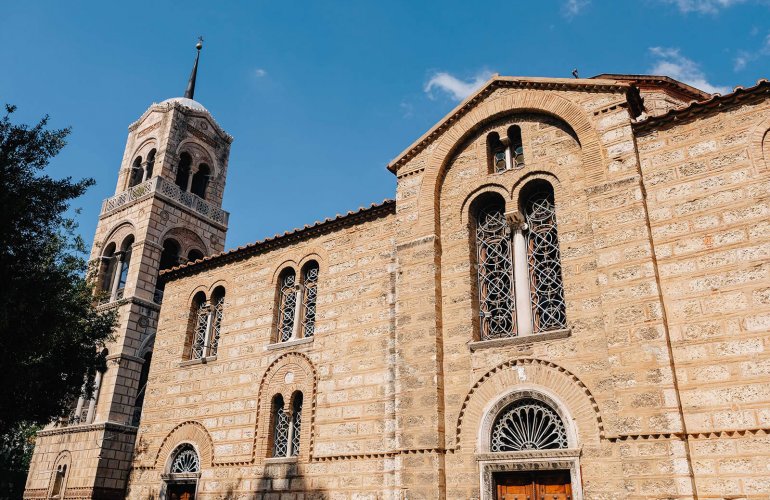
Photo: Georgios Makkas
Roman Baths
When excavation works were undertaken to create ventilation for the Athens metro, the well-preserved ruins of a large Roman bath complex were unearthed in the spot where the Ilissos River once flowed. You can see a portion of these fascinating ancient ruins, which date from the 3rd century AD, at the Zappeion end of the National Garden.
Bypassing the Roman Baths, we track once again, on the left interior side of the pavement, the metal fencing of the National Garden and we proceed straight, keeping it on our left.
After a while, for a few steps the texture of the ground becomes metallic, because of the ending of the metro ventilation. Our course can continue normally.
Venturing straight, we find in front of us the perpendicular Vasilissis Olgas Avenue. While we keep following the left interior side of the pavement, we turn left. There, we bypass the statue of Lord Byron.
Continuing our straight course, we find the car entrance for the parking of Zappeion, vertically in front of us. We do not step down off the pavement to cross it, but we turn 90° to the right and we vertically cross Vas. Olgas Avenue, on which we are stepping, to move from the left pavement to the right.
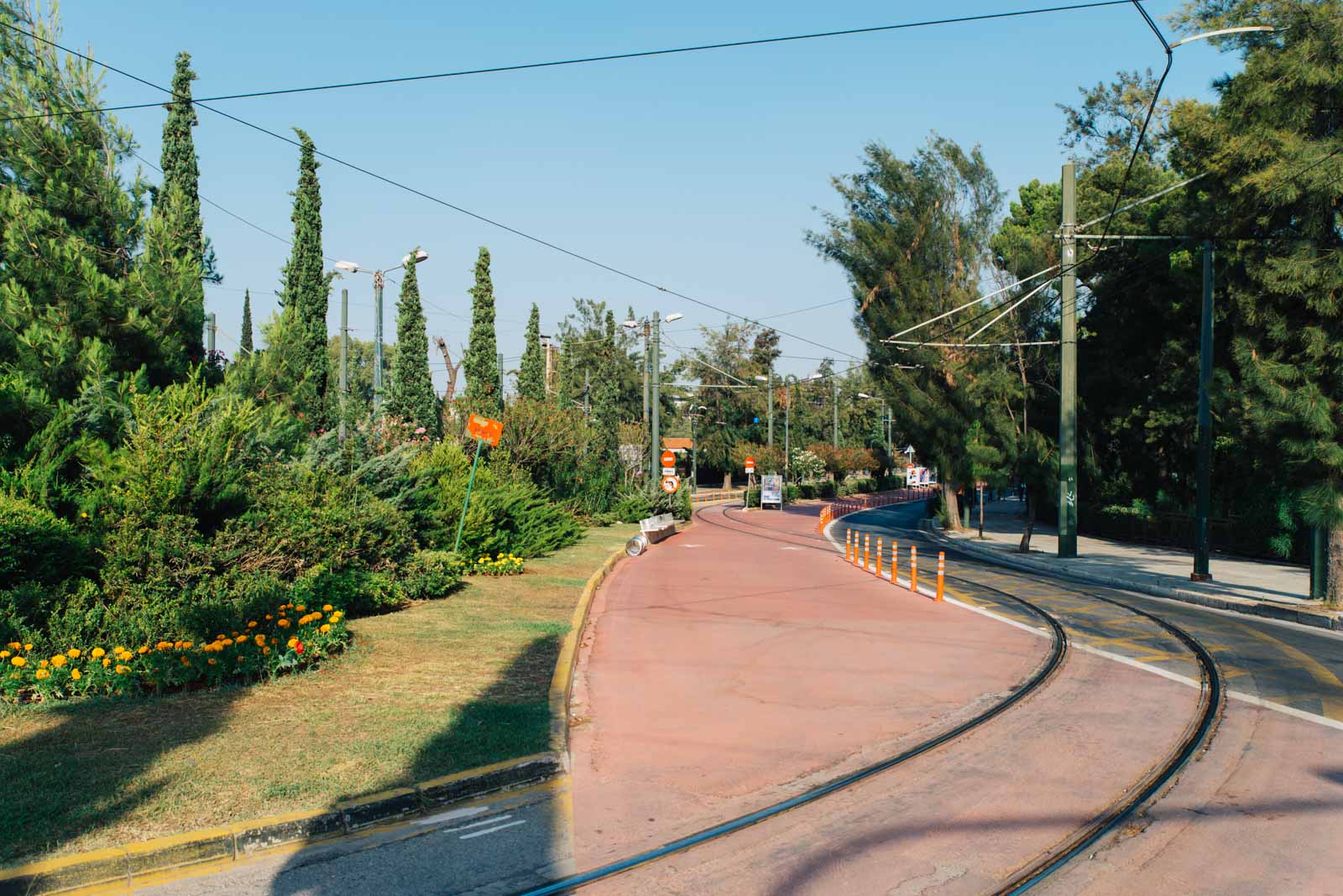
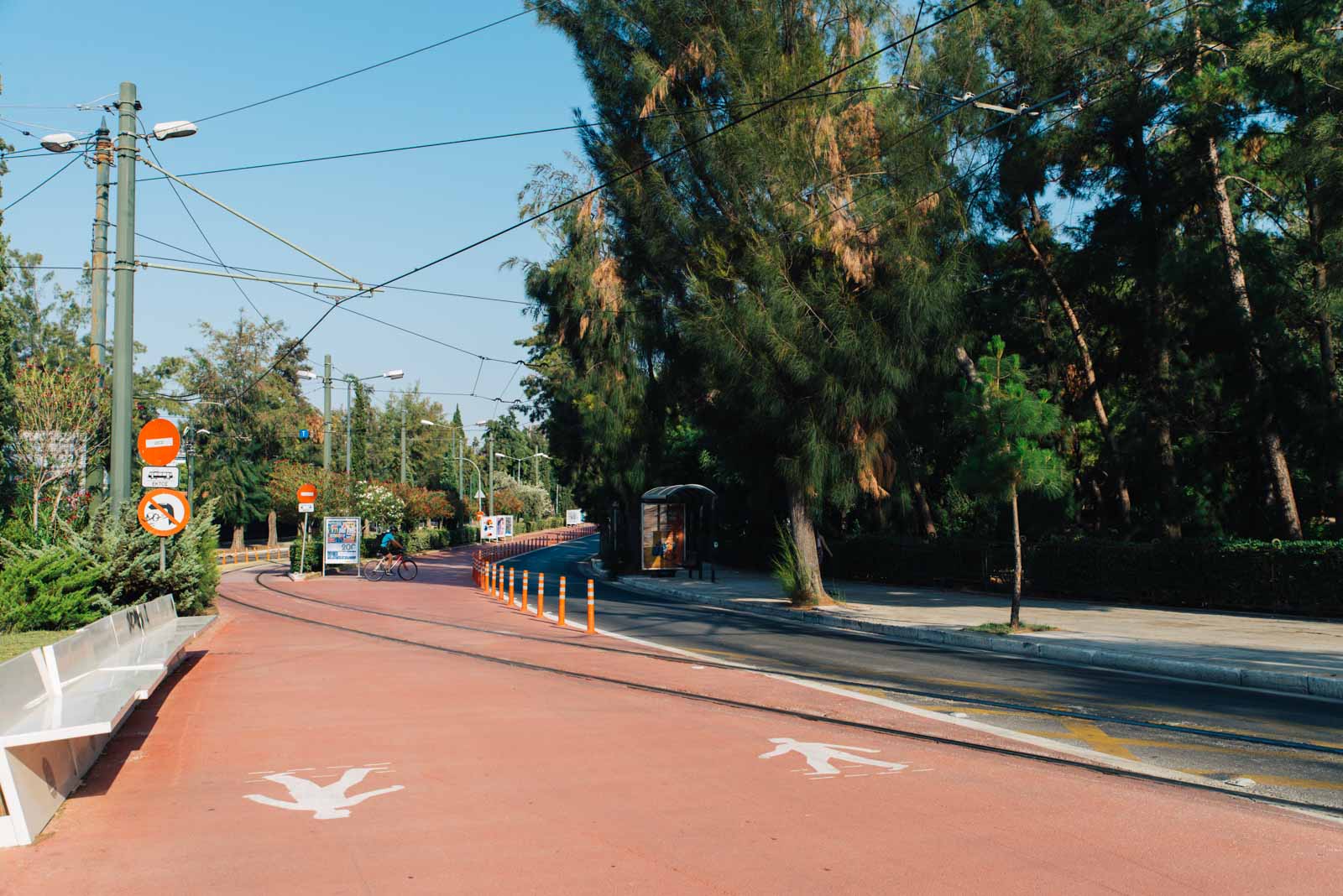
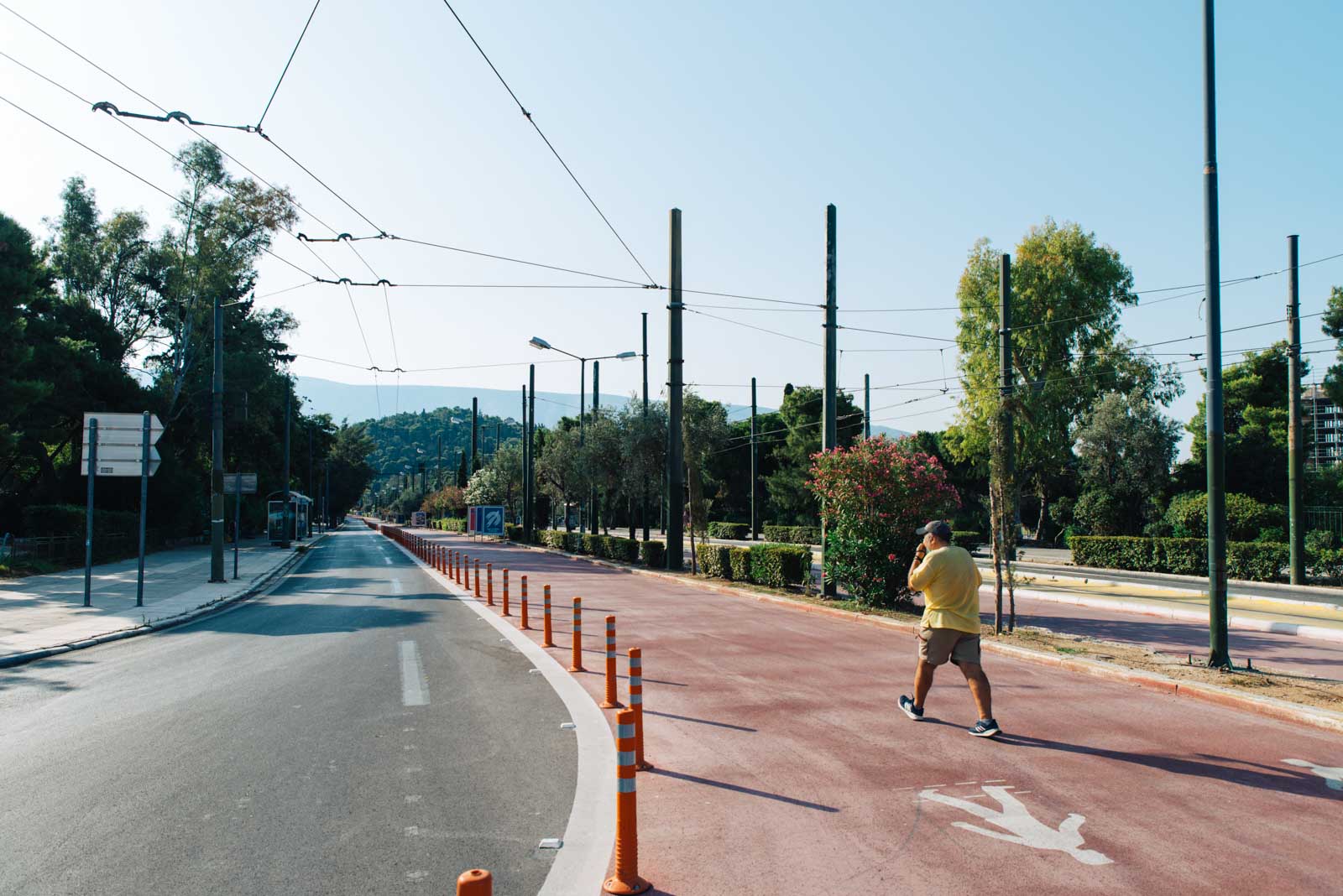
We note that at this point there is a pedestrian crossing, while Vas. Olgas Avenue is a wide street of light traffic, with a median strip, bicycle lanes, pedestrian area and tramway tracks.
As we reach the opposite (right) pavement of Vas. Olgas Avenue, we find a tactile paving vertically in front of us. There:
- If we follow it to the right, for 200 metres, the tactile paving will be interrupted and we will step onto soil. At this point, on our right, the marble Hadrian’s Arch extends which can be freely felt for. We track the tactile paving anew to return.
- If we follow the tactile paving to the left, we will head to the rest of the itinerary and the Olympieion. The tactile paving has a junction with options to the right and straight ahead. If we follow it to the right, we will be led to the entrance of the archaeological site of Olympieion.
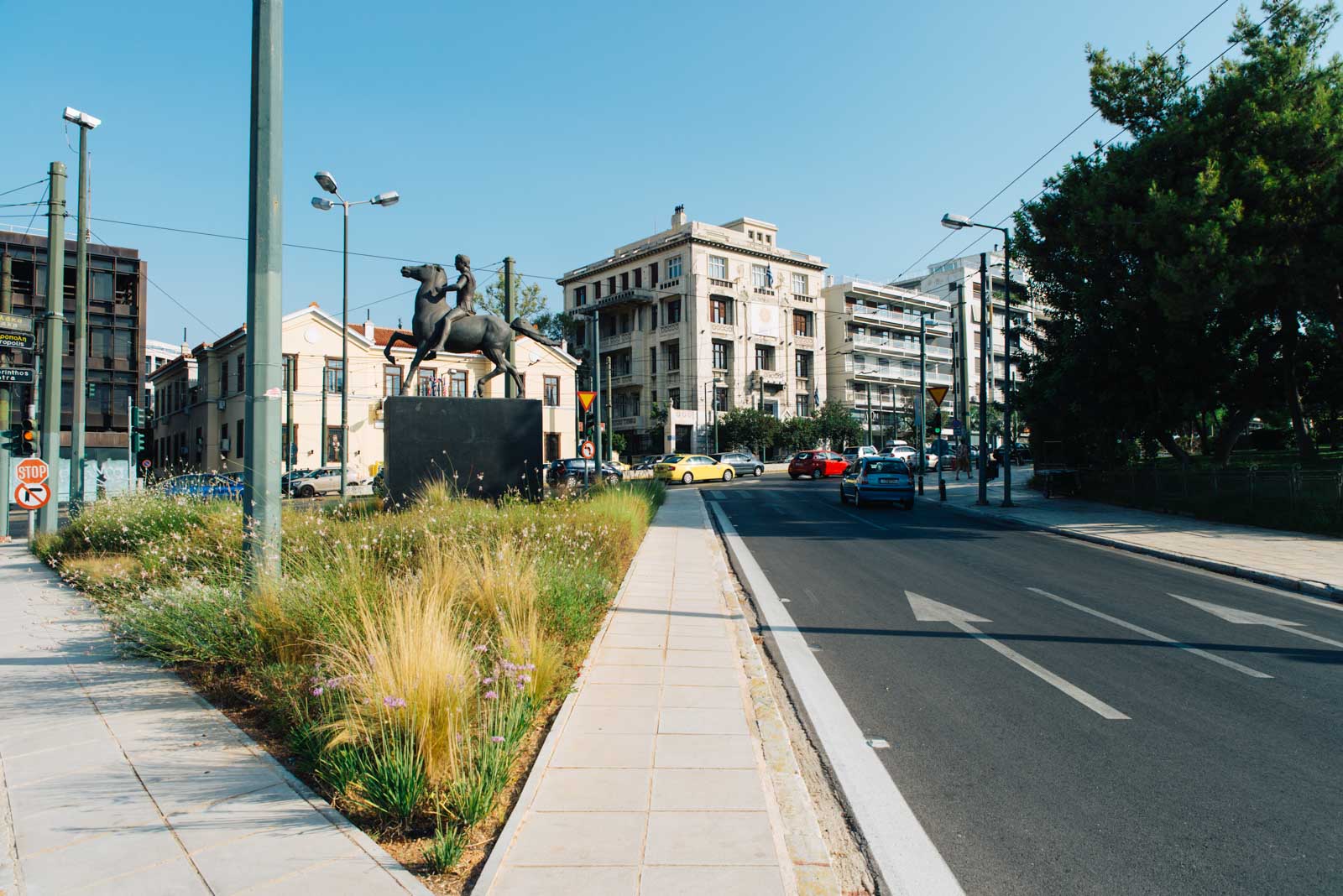
Hadrian’s Arch
Eighteen metres tall and sculpted from solid marble, Hadrian’s Arch (built c.131-134 AD by the Emperor Hadrian) is the monumental gateway to two eras: step back, or east, into Greek antiquity and forward, or west, towards Roman Athens.
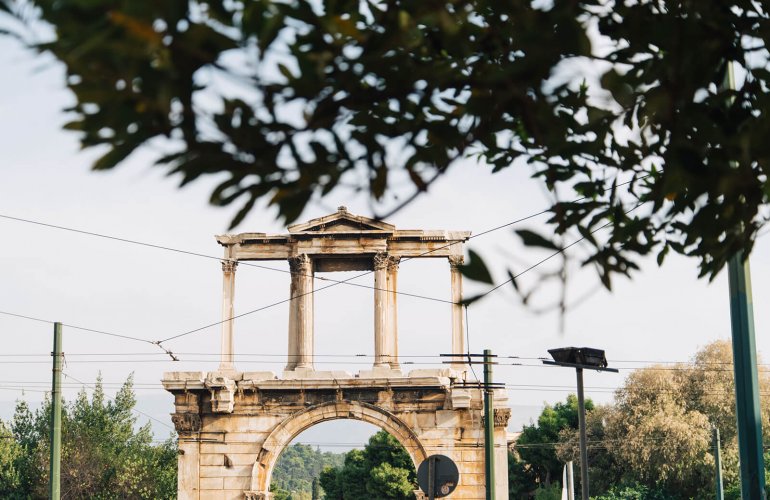
Photo: Thomas Gravanis
Olympieion / Temple of Olympian Zeus
The Temple of Olympian Zeus was once a massive monument devoted to Zeus, bang in the centre of Athens. Construction spanned over seven centuries as successive rulers ensured it was big enough to reflect the mighty god’s stature. Almost 100 metres long and nearly 50 metres wide, the Olympeion was ultimately the largest ancient temple on the Greek mainland—but by the 15th century, only 20 columns remained standing. Today, there are 15.
Tickets: Disabled people upon presentation of their ID card or passport and Disability Certificate are admitted free of charge. In case of 67% disability or more, one escort also has free entrance. This site is included in the combined 5-day ticket of Acropolis & Slopes, Ancient Agora, Roman Agora, Hadrian's Library, Olympieion, Kerameikos, Aristotle's School with a cost of €30.
Accessibility of the site according to the website:
- Tactile floor plans and brochures are provided in Braille (in Greek and English) for visitors with visual impairment.
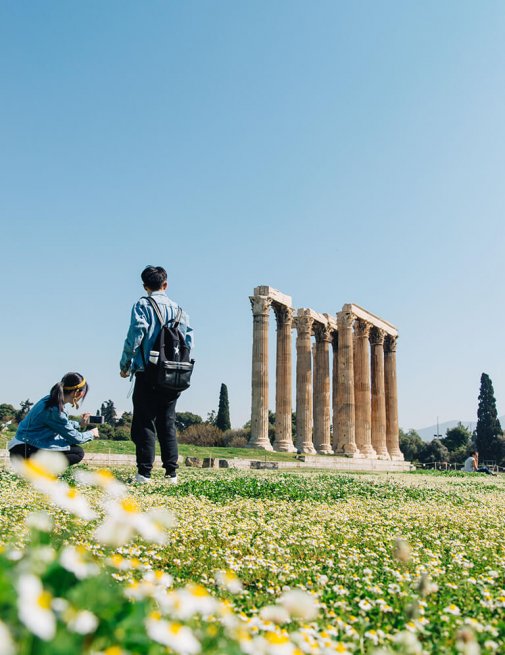
Photo: Thomas Gravanis
Once we exit the archaeological site of the Olympieion, we find the tactile paving and we follow it to the right.
We keep walking straight following the tactile paving as it continues, proceeding carefully as there are many tall plants in our way.
As we continue, while remaining on the right pavement of Vas. Olgas Avenue, we will bypass the Zappeion tram station on our left. Trams passing from this station head back to Syntagma. A little later, we will reach Vasileos Konstantinou Avenue vertically in front of us.
The tactile paving leads us right to the pedestrian crossing. On our next steps we will cross 3 traffic lights in total, with no sound signals. We recommend using a sighted person´s assistance whenever possible.
From the pedestrian crossing, we vertically cross the tramway tracks, including a street lane, and we are now on a median strip.
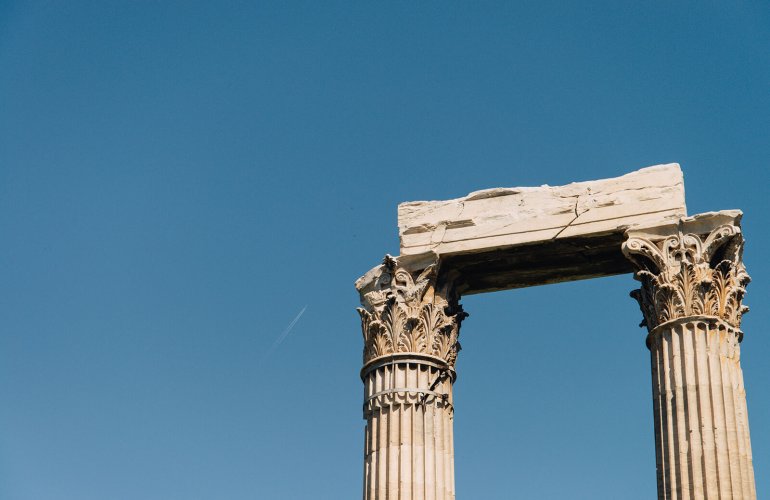
Photo: Thomas Gravanis
Attention: It is a triangular median strip at the same level with the street, so it is not above-ground. That is why we will have to shift slightly to the right at this time, seeking for a stable flower bed on the median strip. At this point we are still on Vas. Olgas Avenue.
Now, bypassing the flower bed and keeping it steadily on our right, we can cross the descending street lanes of Vas. Konstantinou Avenue very carefully. We will reach the slightly elevated median strip of Vas. Konstaninou Ave. On this median strip, on our right, we have the Zappeion tram station. Trams passing from this station head to SEF (Peace and Friendship Stadium) or Voula (Athens Riviera).
From the median strip, we will have to cross the other half of this main street (meaning the tramway tracks and the ascending street lanes) with caution. On the opposite pavement of Vas. Konstantinou Ave. we turn left, leaving the wall on our right and using the interior side of the pavement.
After the wall, we continue following the metal flower bed along the interior side. Soon we meet the Mets bus station, which we bypass.
As we keep following the interior side of the pavement, we have the metal fencing as our point of reference. The first nook we meet is the entrance for the park of Ardittos Hill.
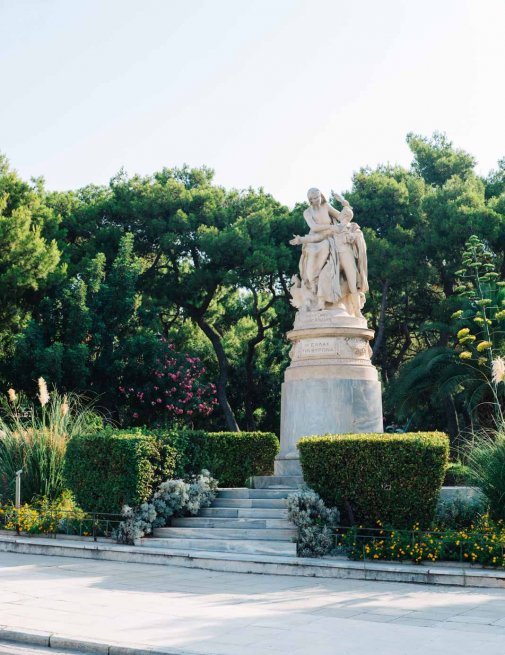
Photo: Thomas Gravanis
Ardittos Hill Park
Wander up the wooded trails of Ardittos Hill for an unexpected portrait of the Acropolis—and expansive views down over the all-marble Panathenaic Stadium, birthplace of the modern Olympics.
Proceeding straight, we find the metal fencing on the interior side once again. As soon as it finishes, we locate some marble bollards.
If we turn right, passing through the bollards, we enter the vast site of the Panathenaic Stadium. At the forecourt, on our right, we discover the statue of our national benefactor, George Averoff. Alternatively, we continue straight. The entrance to Kallimarmaro Stadium extends until the pedestrian crossing in front of us.
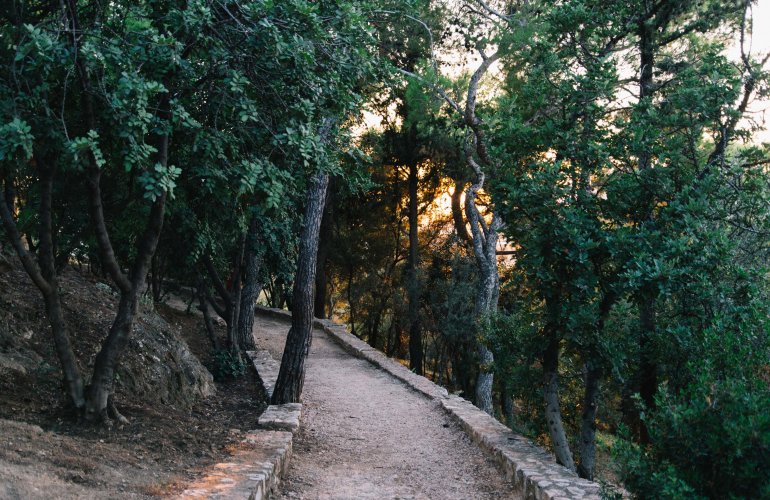
Photo: Thomas Gravanis
The Panathenaic Stadium
This remarkable all-marble stadium was first laid in 330 BC as a venue for ancient athletics and gladiatorial clashes. It was reworked to host the first modern Olympic Games in 1896 and today, it’s the finishing line for the world-famous Athens Marathon.
The pedestrian crossing at the entrance of the stadium is equipped with an auditory signal. At the same time, a voice output informs the pedestrians that they are in front of Kallimarmaro, heading in the direction of Irodou Attikou Street.
This particular pedestrian crossing:
- provides audible information for the location. The auditory signal device is located on the pole of the traffic light and at a height of about 1 metre above the ground. At the bottom there is a round button, which speaks in Greek and English if we press it, to confirm where we are and towards which direction we are preparing to cross the road.
- provides additional colour contrast for people with partial loss of vision.
- has a vibrating signal for deaf-blind persons.
- has an auditory signal. The slow-paced signal means red for the pedestrians, while the fast-paced one means green, so the pedestrian can cross the street.
- features embossed marking at the top of the auditory signal device, with an arrow to indicate the direction of the course we are on.
- provides tactile information regarding the size of the pedestrian crossing and the streets we traverse.
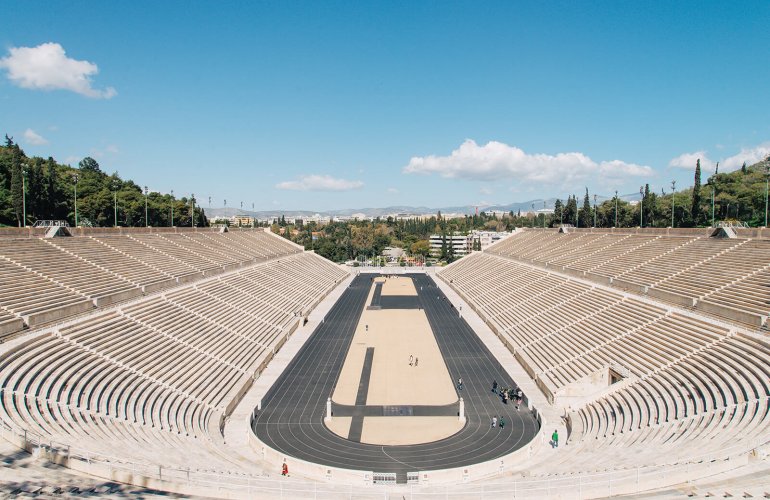
Photo: Thomas Gravanis
From now on, we will describe the itinerary of our way back to “Syntagma” metro station.
We are now on the right pavement of Vas. Konstantinou Ave. On our left, we have the modern pedestrian crossing we described above, while still having Kallimarmaro on our right.
We locate the pedestrian crossing and cross Vas. Konstantinou Ave. reaching its median strip. At this point there is another traffic light with an auditory signal. We cross the other half of Vas. Konstantinou Ave and we now have Irodou Attikou Street extending on our left.
Crossing Vas. Konstantinou Ave., we turn 90° to the left, so that we now have Irodou Attikou Street vertically in front of us. There is a traffic light with auditory and tactile signals here as well, so we vertically cross.
Once across, we turn left on the pavement, leaving the metal fencing of the National Garden on our right. We continue following the fencing and bypassing a nook at some point.
We are now on Vas. Olgas Ave. in the direction of Syntagma.
At some point, the metal fencing ends and vertically in front of us there is a street that continues towards the right. This is where the Aegli cafe is located as well as Cine Aegli, both of which offer parking lots for disabled people free of charge. An accessible playground is also nearby.
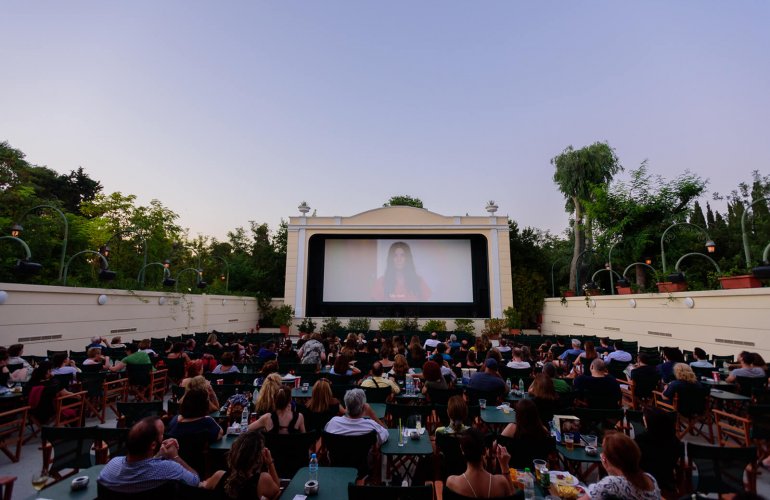
Cine Aegli
Athens’ oldest open-air cinema opened in 1903 in the garden of stately Zappeion Hall, next to the former palace and royal gardens, and is regarded by many as one of the loveliest venues in Europe to enjoy a summer screening under the stars.
We continue straight and vertically cross this street, which is technically a car entrance-exit. We find the pavement of Vas. Olgas Ave. once again and we continue following its interior side.
Shortly after that, the interior fencing is interrupted by the main entrance to the Zappeion, where there is also a change of texture on the ground.
Courtesy: Aegli
Zappeion Megaron
This stately conference and events venue next to the National Garden was originally built in 1888 for the first modern Olympic Games and is named for its benefactor, the great Greek philanthropist Evangelos Zappas.
- The mansion is only open when hosting events and conferences.
If we do not enter Zappeion, we will continue straight from the interior side of the right pavement on Vas. Olgas Avenue.
On our way, we will bypass another car entrance to Zappeion, leaving it on our right hand and continuing straight. We now retrace backwards the itinerary heading to Syntagma metro station where we began.
Reaching the stairs of the Syntagma metro station, we can leave them on our right. Continuing from the interior side, we find a pedestrian crossing in front of us. We vertically cross the street that leads to the parking of the Hellenic Parliament.
As soon as we cross the street in front of the parking space, we take a diagonal course to the right and we locate the dividing wall that demarcates the forecourt of the Parliament. On the dividing wall, there is a big, metal shield which features an embossed image of “Argo”, the mythical ship of the Argonauts.
We leave the wall on our right and, always following the right interior side as it goes, we will reach the steps leading to the Tomb of the Unknown Soldier. It is worth standing here for a while, listening to the Evzones’ movements, as they change shift on the hour.
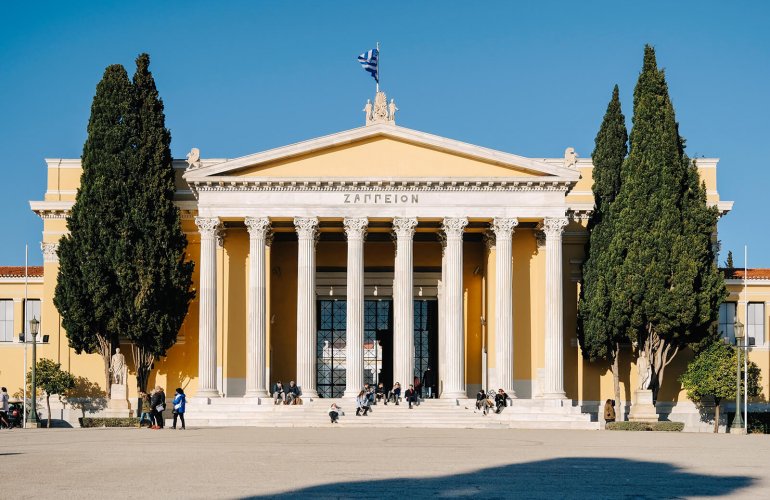
Photo: Georgios Makkas
Hellenic Parliament / Tomb of the Unknown Soldier
The Hellenic Parliament and the Tomb of the Unknown Soldier are guarded by the Evzones, aka tsoliades—and together, they form one of the city’s most-photographed spectacles. Excerpts from the funeral oration of Pericles are chiselled into the marble as a poignant reminder of the cost of war, while the The Presidential Guard, or Evzones, resplendent in traditional 19th-century male costume, symbolise the Greek military (their distinctive kilts have 400 pleats, one for each year of Ottoman rule).
- The Parliament is not open to the general public.
- The change of the guards’ shift takes place every one hour on the square.
Following the opposite direction, we return to the Syntagma metro station where we finish our itinerary.
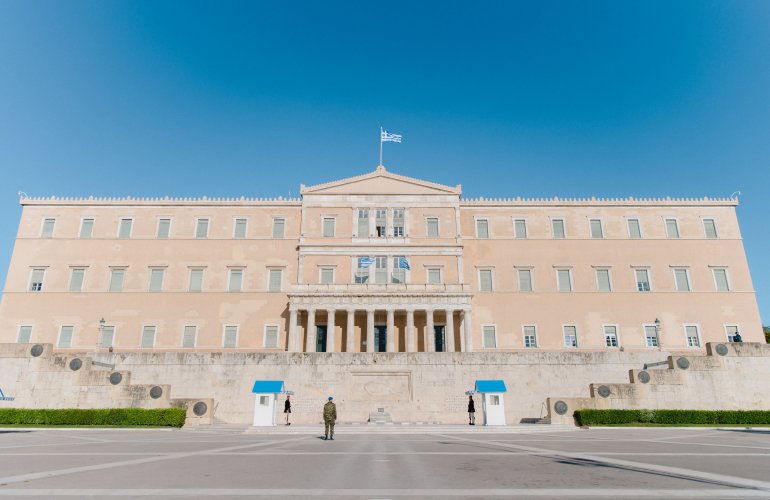
Photo: Thomas Gravanis